
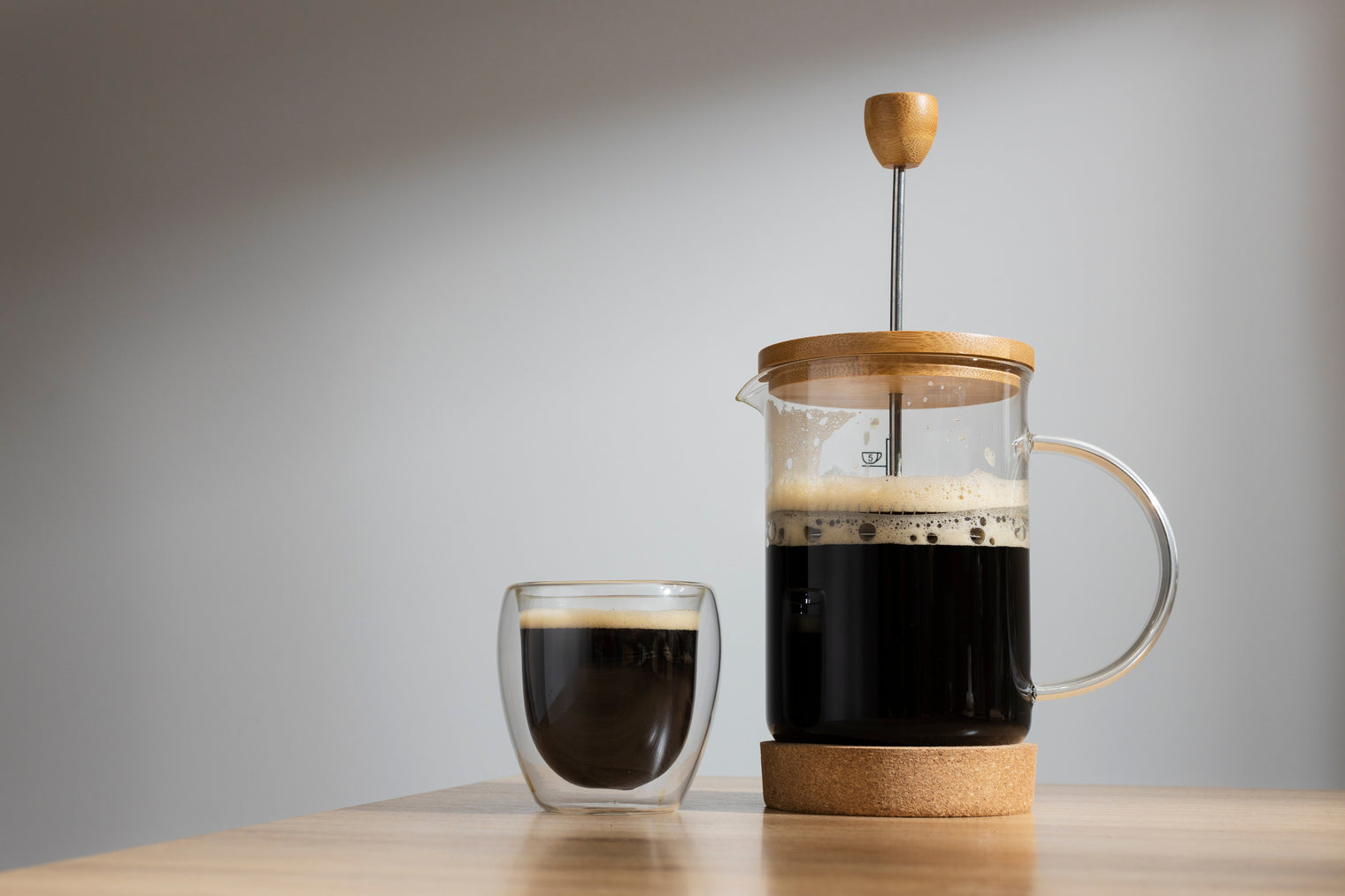
The French Press is uncomplicated – and that is precisely why mistakes often creep in. With the right grind size, water, and brewing time, you will always succeed in making an aromatic, well-rounded cup.
The French Press is wonderfully uncomplicated – and that is exactly why many people fall into the same traps: grinding too fine, pouring water that is too hot, letting it steep for too long... The result? Bitter, cloudy, or watery. Here, you will find a practical guide to help you avoid typical French Press mistakes and reliably brew a well-rounded, aromatic cup.
Unlike paper filters, the metal filter of the French Press allows more oils and fine particles to pass through. This provides a full body and a "velvety" mouthfeel. However, this very strength can easily turn into a weakness if the grind size, ratio, temperature, and steeping time are not quite right. The good news: with a few clear adjustments, you can reliably get this under control.
1) Equipment & Preparation: Small details, big impact
The right French Press
Glass is light and transparent (you can see the extraction), stainless steel retains heat better, and ceramic is sturdy and neutral in taste. It is important that the plunger fits tightly and the sieve is clean – otherwise, unnecessary sediment ends up in your cup.
Grinder, scale & timer – your quality guarantees
- Grinder: A good hand or electric grinder delivers an even, coarse grind. Blade grinders create too much "dust" (fines) → muddy cup.
- Scale & timer: Consistency is everything: hit the ratio (e.g., 1:15–1:16) and steeping time exactly.
- Fresh beans: It tastes vibrant shortly after the roast date; store in an airtight, cool, and dark place.
2) Grind size: The biggest lever against bitterness & sludge
For the French Press, the rule is: grind coarse – roughly like sea salt / breadcrumbs. If the grind is too fine, you will quickly over-extract: the coffee becomes bitter and contains a lot of sediment. If it is too coarse, it becomes under-extracted and watery. Guides therefore recommend a coarse to medium-coarse grind and slight variations depending on the bean/roast profile.
Rule of thumb for fine-tuning:
- Bitter, fuzzy, dull: Set the grind coarser, lower the temperature, shorten the steeping time.
- Watery, sour, thin: Grind slightly finer, increase the dosage, or let it steep longer.
3) Dosage & ratio: 1:15 to 1:16 as a reliable start
The following ratios have proven effective for most beans:
- Ready-to-drink: 1:15 to 1:16 (e.g., 30 g of coffee to 450–480 g of water)
- Stronger: 1:14 (more body, more sweetness – but a higher risk of bitterness)
Many brew guides recommend about 60–65 g of coffee per 1 liter. Important: Always use a scale – spoons are inaccurate.
4) Water: Temperature, quality & preheating
Target range: 92–96 °C. This usually corresponds to water that has just boiled and cooled for 30–60 seconds. Too hot (>96 °C) promotes bitterness; too cold (<90 °C) tastes flat. Preheating the carafe and cups reduces heat loss and stabilizes the extraction.
Water quality also counts: medium hardness (approx. 70–150 ppm TDS) often brings out the aromas more clearly. Very hard water can emphasize bitterness, while very soft water can taste flat. If you want to perfect it, try filtered or blended water.
5) Steeping time: 3–4 minutes – and adjust accordingly
A steeping time of 3–4 minutes has proven to be the standard. The biggest influences are grind size and roast level:
- Light roast: Often let it steep a bit longer or grind slightly finer (otherwise the acidity stands out too much).
- Darker roast: Prefer a shorter time / grind slightly coarser (otherwise bitterness quickly becomes dominant).
Tip: Taste it after 3:30 minutes. If it is already well-rounded, plunge slowly. If it is still too thin, wait another 20–30 seconds.
6) Pouring, stirring & plunging: gentleness wins
- Pouring: Pour in a circular motion so that everything is wetted. Let large bubbles ("bloom") escape briefly.
- Stir gently: 1–2 times is enough. Too much movement releases fines → cloudy & bitter.
- Place the plunger: Just rest it on top (without pressing) to keep the heat inside the carafe.
- Pressing: After 3–4 minutes, press evenly and slowly, without jerking.
7) Common French Press mistakes – and the quick fix
| Problem | Likely cause | Fix |
|---|---|---|
| Bitter | Too fine, too hot, too long | Coarser grind, 92–94 °C, 3:30–4:00 min. |
| Sour/watery | Too coarse, too cold, too short | Grind finer, 94–96 °C, up to 4:00 min. |
| Cloudy/muddy | Many fines, dirty sieve, pressed abruptly | Better grinder, clean sieve, press slowly |
| Flat | Water too soft/hard, old beans | Optimize water, fresh beans |
8) After pressing: Pour out immediately & manage sediment
Do not leave the coffee in the carafe – even after plunging, it continues to extract and will turn bitter. Pour immediately into your cup or a server. If residual sediment bothers you: a second, quick filtration through a paper filter (e.g., into a Hario V60 filter) makes the cup clearer – with slightly less body.
9) Cleaning & care: Old oils = bad taste
Metal filters hold back oils – and these stick to the sieve. If you do not regularly take the French Press apart and clean it, you will quickly get a "musty" cup. So: clean with hot water and mild dish soap after every use, and deep-clean regularly (take the sieve/spiral apart). This reduces bitter-tasting old oils and keeps the flavor fresh.
10) Fine-tuning to your taste: Light vs. dark, clear vs. creamy
- Light roasts: Slightly finer grind or minimally longer time to emphasize sweetness and complexity.
- Dark roasts: Prefer coarser and shorter – otherwise it turns bitter.
- Clearer cup: Grind minimally finer, then wait a moment after pressing for the sediment to settle before pouring carefully.
- More body: Ratio 1:14–1:15; but keep an eye on bitterness.
11) Step-by-step recipe (reliable starting point)
- Preheat carafe & cup.
- Grind 30 g of coffee coarsely, have 480 g of water ready (1:16).
- Pour evenly with 94 °C water until everything is wetted. Stir gently.
- Place the lid on (without pressing) and let steep for 3:30–4:00 min.
- Press slowly and evenly, pour out immediately.
12) Health note: Unfiltered coffee & cholesterol
Unfiltered brewing methods (French Press, Turkish) allow diterpenes like cafestol/kahweol to pass through, which can raise LDL cholesterol. For most people, moderate consumption is unproblematic, but those who are LDL-sensitive should prefer paper-filtered methods – or not use a French Press daily.
13) Frequently Asked Questions (FAQ)
Which grind size is ideal for the French Press?
Coarse – about like sea salt. Too fine a powder leads to bitterness and a lot of sediment.
How much coffee per water should I use?
Good starting points are 1:15 to 1:16 (e.g., 60–65 g per 1 liter). Then fine-tune to your taste.
How hot should the water be?
92–96 °C, meaning freshly boiled and cooled for 30–60 s. Too hot intensifies bitterness.
How long should it steep?
3–4 minutes is a reliable range; lighter roasts can often handle a bit more time.
How do I prevent a muddy cup?
Grind coarsely, stir gently, keep the sieve clean, and press slowly. Optional: After pressing, let it rest for 30–60 s and pour carefully, or "polish" it by pouring through a paper filter.
14) Short conclusion
You don't need magic for great French Press coffee – just clean technique: grind coarse, use a 1:15–1:16 ratio, 92–96 °C water, steep for 3–4 min, press slowly, and pour immediately. With this setup, bitter, watery, or muddy cups are a thing of the past – instead, you get a well-rounded, aromatic cup with a beautiful body.


