
Why specialty coffee often tastes sour and why that is not a bad thing
Why coffee tastes acidic and why exactly that often stands for quality, freshness, and genuine flavor.

Perhaps you have experienced this before. You try a new coffee, maybe even one from a roastery, and suddenly it tastes different than expected. Not bitter, not strong, but somehow acidic. For many, this is the exact moment they think: This surely cannot be good coffee.
And this is precisely where one of the biggest misunderstandings about coffee begins. Because what many perceive as "too acidic" is often exactly what defines high-quality coffee.
This article is not about sugarcoating anything for you. It is about showing you why coffee tastes the way it does and how you can interpret that for yourself.
Why does coffee suddenly taste acidic even though it should be good
Expectations for coffee are very similar for many. It should be strong, perhaps slightly bitter, but never acidic. This expectation often comes from classic coffee that is roasted very dark.
Specialty coffee is different. Here, the process consciously avoids "roasting everything away." Instead, more natural flavors are preserved. And it is precisely these flavors that can come across as fruity or slightly acidic.
The problem, therefore, is not the coffee, but the expectation of it.
Is coffee acidic or bitter and what does that even mean
Acidity and bitterness are often confused. Yet, they are two completely different things.
Acidity in coffee provides freshness. It makes the coffee vibrant and clear. You can imagine it like the light acidity in fruit. It is not aggressive, but rather adds tension to the taste.
Bitterness, on the other hand, is often caused by very dark roasting or improper preparation. It feels heavier, sometimes even unpleasant, and masks other flavors.
Many are primarily familiar with bitter coffee and therefore automatically interpret any form of acidity as a flaw. This is exactly where the misunderstanding arises.

Why specialty coffee often tastes more acidic than regular coffee
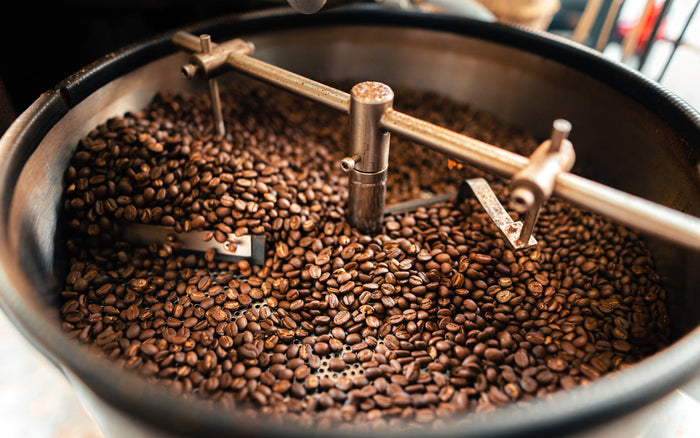
Specialty coffee is usually roasted lighter. As a result, more natural aromas are preserved. While many of these aromas are masked in dark roasts, they stand out more here.

This does not mean the coffee is "made more acidic." On the contrary. It means it is less manipulated. You taste more of what is originally in the bean.
Depending on the origin, this can vary greatly. Some coffees are more chocolaty and smooth. Others bring fruity or floral notes with them.
Why coffee can taste fruity and why many misunderstand this
Coffee is essentially a fruit. To be precise, a coffee cherry. That is why it is perfectly normal for certain coffees to develop fruity aromas.
This fruitiness is often interpreted as "acidic," even though it is actually a sign of quality. High-quality coffees in particular can have notes of berries, citrus fruits, or even floral aromas.
Once you experience this consciously, your view of coffee changes completely.
An example of this are particularly fruity and complex coffees like a Sudan Rume from El Salvador. Such coffees demonstrate very clearly that coffee does not just have to be bitter or strong, but can also be vibrant, clear, and complex.
Especially if you previously thought that acidic coffee was something negative, such a coffee can completely change your understanding.
Typical reasons why coffee tastes unpleasantly acidic
Not every acidity is automatically good. There are also situations where coffee truly tastes unpleasantly acidic. And these differences are precisely what matter.
A common reason is the grind size. If the coffee is ground too coarsely, it is not extracted properly. The result is a thin, unbalanced taste that is often perceived as acidic.
The coffee-to-water ratio also plays a role. Too little coffee or a contact time that is too short can lead to important flavors being missing.
In these cases, the acidity is not the problem, but a sign that something in the preparation is not optimal.
When acidic coffee is a problem and when it is not
The difference lies in the sensation while drinking. Good acidity feels fresh, clear, and pleasant. It does not disappear immediately but remains as a vibrant note in the taste.
Unpleasant acidity feels sharp, hollow, or unbalanced. It stands alone and is not accompanied by other flavors.
When you learn to perceive this difference, coffee suddenly becomes much more understandable.
How to properly interpret the taste of coffee
Coffee never consists of just one characteristic. It is always a combination of different impressions. Sweetness, acidity, and bitterness form the base together.
A good coffee is balanced. This does not mean it is neutral. Rather, it means the individual elements fit together well.
Once you understand that, you stop categorizing coffee into "good" or "bad." Instead, you begin to distinguish what you personally enjoy.
How to find out which coffee suits your taste
There is no single perfect coffee for everyone. Taste is always individual. Some prefer chocolaty, smooth coffees. Others like fruity and complex profiles.
The best way is to try different directions. That way, you get a feel for what you really like.
If you are unsure or need some guidance, you can get in touch at any time via the contact page. Often, a few questions are enough to find the right entry point.
Why your coffee at home often tastes more acidic than in a café
Many think the difference lies in the coffee itself. In reality, the preparation plays a major role.
In a café, the grind size, quantity, and extraction are precisely calibrated. At home, it happens quickly that the coffee is ground too coarsely or the ratio is off.
As a result, the coffee often tastes more acidic, even though the bean is actually good.
But that also means: You can influence this yourself.
FAQ about acidic coffee
Why does my coffee taste acidic
It is often due to under-extraction, the wrong grind size, or an unbalanced ratio. Sometimes, however, it is simply the natural fruitiness of the coffee.
Is acidic coffee bad
Not necessarily. Pleasant acidity is a sign of quality. It only becomes problematic if the coffee tastes unbalanced or sharp.
How can I get less acidity in my coffee
A finer grind, more coffee, or a longer extraction can help. The choice of bean also plays a role.
Which coffee has little acidity
Coffees with a chocolaty or nutty profile often taste less acidic. These are particularly well-suited for beginners.
Why does filter coffee taste acidic
It is usually due to a grind size that is too coarse or an extraction that is too short. Small adjustments here can change a lot.
A new look at acidity in coffee
Perhaps acidity in coffee is not the problem at all. Perhaps it is simply part of what makes coffee exciting.
If you begin to see it not as a flaw, but as a characteristic, a completely new perspective opens up. Suddenly, it is no longer just about whether a coffee is strong or mild, but about what it really shows.
And that is exactly where, for many, the moment begins when coffee is no longer just a drink, but a true taste experience.